← Back to articlesFlash Alexandre4 min read
The vibe coding trap: 97% of AI-generated apps never ship
Forbes named it today. 92% of devs use AI coding tools daily, 46% of new code is AI-generated — and 97% of vibe-coded apps never make it to production.
Alexandre4 min read
Forbes · Business Insider · Hashnode — April 9, 2026
Click to enlarge
92% of American developers use AI coding tools daily. 46% of new code is now AI-generated. Trust in that code has dropped from 77% to 60% in a single year.
And 97% of vibe-coded apps never ship.
Forbes published a piece this morning: "The Vibe Coding Trap Ambitious Founders Fall Into". The same week, Business Insider documents solopreneurs making six figures with Lovable. OpenBuilder raises $2.2M to fix vibe coding's "pricing problem". Everyone's talking about it — with opposite conclusions.
Here's what the numbers actually say.
The ecosystem that exploded in 8 months
Vibe coding — writing code through natural language prompts without touching a keyboard — went from Twitter trend to multi-billion dollar market in under a year. Andrej Karpathy coined the term in 2025. Collins Dictionary named it "word of the year". The platforms raised eye-watering amounts.
| Platform | Valuation | ARR | Latest round | Target |
|---|---|---|---|---|
| Cursor | $29.3B | $2B | $2.3B Series D (Nov. 2025) | Technical devs |
| Lovable | $6.6B | $300M | $330M Series B (Dec. 2025) | Non-technical / MVP |
| Replit | undisclosed | $100M | Series C (a16z, Khosla) | All-in-one cloud IDE |
| Emergent | undisclosed | $100M | undisclosed | General public |
Emergent illustrates the scale better than anything: 6 million users, 150,000 paying subscribers across 90 countries, $100M ARR. In eight months. Cursor alone claims 7 million active developers and 1,100% year-over-year growth.
Hashnode sums up the market in its "State of Vibe Coding 2026" report:
"Vibe coding won the adoption war. The quality war is just starting."
Adoption is not the question anymore. It already happened.
The trap Forbes documents today
The "vibe coding trap" that Jodie Cook describes in Forbes this morning is the exact moment a founder realizes that generating code and understanding code are two different skills — and they only have one.
The pattern Forbes documents: rapid prototype, excitement, product investment, inability to maintain, complete blockage. The code runs, but no one on the team can audit it, extend it, or fix non-trivial bugs.
The most brutal number of the week comes from Hashnode: 97 to 98% of vibe-coded apps never reach production. Devs report +74% productivity gains — but trust in the generated code has fallen from 77% to 60% over twelve months.
Apple is responding in its own way. According to The Next Web, App Store submissions have surged 84% since the vibe coding explosion. Most are rejected. Apple has tightened its review criteria accordingly.
OpenBuilder, a YCombinator Fall 2025 graduate, raised $2.2M this month by directly attacking the pricing issue. Their founder Li explains in Business Insider:
"Our bet is that over time, users are going to become educated and aware enough of the landscapes that eventually it will shift to more fixed pricing."
Pay-per-use becomes unsustainable as a project grows and accumulates bugs. It's an indirect admission that pure vibe coding — without human oversight — doesn't scale.
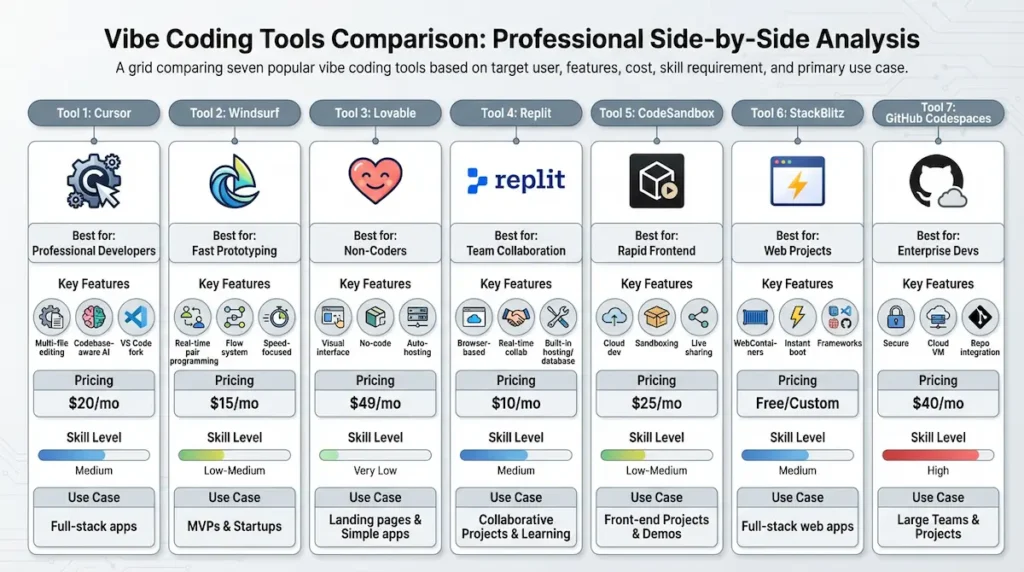
Click to enlarge
My take
The divide isn't between "vibe coding works" and "vibe coding doesn't work". It's between people who can read what the AI generates and those who trust the output without questioning it.
Jacob Klug, founder of a Lovable agency, made $170,000 in a single month building and selling vibe-coded apps, according to Business Insider. Henrik Fasth scaled a virtual try-on tool into an AI fashion platform. These cases are real and documented. But these are people who can audit the produced code. Not rewrite it line by line. Audit it. Understand whether the architecture holds, whether debt is accumulating too fast, whether the next feature will break everything.
I've been building Livate with Claude Code for almost a year using vibe coding. The setup I've put in place — CLAUDE.md, PreToolUse hooks, proactive rules — exists precisely because letting AI code without a framework means accumulating invisible debt, session after session. Without structural rules, even a technical developer ends up in the trap.
The trap isn't the AI. The trap is believing that generating code means understanding code.
What this means for your profile
| Profile | What changes concretely |
|---|---|
| Solo iOS dev | +84% App Store submissions means stricter review. The quality of generated code now directly affects your approval rate. |
| Non-technical founder | 97% of apps never ship. Without someone to audit, the prototype stays a prototype. |
| Senior dev | AI automates repetitive tasks, not architecture. Architectural judgment becomes more valuable, not less. |
| Freelancer / agency | Jacob Klug: $170K in one month with Lovable. The market exists — for those who can maintain. |
Pricing will also shift. Cursor Ultra at $200/month, Lovable credits, Claude tokens — it adds up fast on a serious project. OpenBuilder is betting on a move toward fixed subscriptions. It's not settled yet, but the direction is clear.
Anyone can generate code with AI in 2026. Maintaining code you don't understand is tomorrow's debt.
Alex
- 92% of American developers use AI coding tools daily. 46% of new code is AI-generated. Trust in that code has dropped from 77% to 60% in one year — Hashnode State of Vibe Coding 2026.
- 97 to 98% of vibe-coded apps never reach production. The perceived productivity gain (+74%) masks a quality in free fall.
- The ecosystem is massive: Cursor at $29.3B valuation and $2B ARR, Lovable at $6.6B, Replit at $100M ARR. Adoption won. The quality war is just starting.
- Apple recorded +84% App Store submissions since the vibe coding explosion. Rejections are rising. Review criteria have tightened — The Next Web, April 2026.
- The real trap: confusing generating code with understanding code. The founders succeeding at vibe coding can audit what the AI produces. Not rewrite it — evaluate it.
Related articles

10 Ways to Cut Your Token Bill by 5x (Copilot, Claude Code, Cursor)
Opus at $25/M tokens, Haiku at $5. 10 practical levers to reduce your consumption by 60 to 90% across all AI agents.Dev, AIHow I cut my Claude Code token usage in half
Not with /compact. With what I set up BEFORE opening a session. CLAUDE.md, hooks, and proactive rules: my setup to cut token consumption by 40 to 60%.Dev, AIAI agents don't code for you: they orchestrate. Here's how it actually works
Agentic loop, hierarchical subagents, MCP protocol: a technical deep dive into code agent architecture and lessons learned after 8 months of solo dev with Claude Code.Comments
Comments
Got a take on this article?
Create a free account in 10 seconds to comment, like, and get the next articles straight to your inbox.
Don't have an account yet?